Resource & service
VPAT & document accessibility
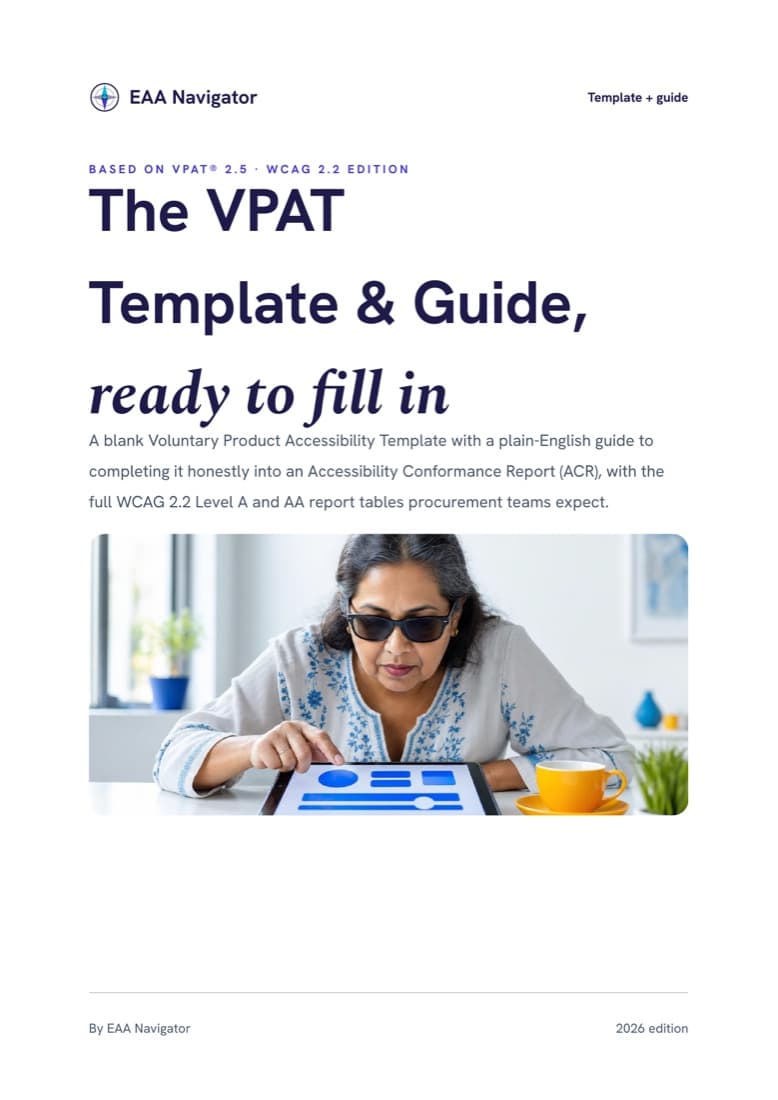
A VPAT is the template buyers ask you to fill in to show how your product conforms to accessibility standards. The completed, accurate version is an Accessibility Conformance Report (ACR). This page explains both, the four editions, and the document-accessibility work that often gets missed.
Reviewed by the EAA Navigator team
TL;DR
- VPAT: the blank template, from ITI.
- ACR: the completed, accurate report — what buyers actually want.
- Four editions: WCAG, 508, EU (EN 301 549) and INT.
- Honest fill-in: a credible ACR needs a real evaluation, not guesswork.
The basics
VPAT vs ACR
VPAT (the template)
The Voluntary Product Accessibility Template, published by ITI. A standard, blank form with a row for each applicable success criterion. On its own it says nothing about your product — it is the structure you complete. ITI
ACR (the report)
The Accessibility Conformance Report: the filled-in VPAT. Each criterion marked supports, partially supports or does not support, with honest remarks. This is what a buyer means by “send us your VPAT”. Section508.gov
Four editions
Pick the edition your buyer needs
WCAG
Maps to the W3C Web Content Accessibility Guidelines — the web standard most buyers reference.
508
Maps to US Section 508, the standard for US federal procurement.
EU
Maps to EN 301 549, the EU harmonised standard behind the EAA and public-sector rules.
INT
An international edition combining WCAG, 508 and EN 301 549 in one report.
Editions per ITI's VPAT. ITI VPAT
Who requests a VPAT, and why
VPAT/ACR requests come from buyers who need to compare products on accessibility before they purchase.
- US public-sector procurement. Section 508 requires federal agencies to consider accessibility when buying ICT, so an ACR is a routine part of selling to them. US Access Board
- Enterprise buyers. Large organisations fold accessibility into vendor due diligence and ask for an ACR alongside security and privacy documentation. Section508.gov
- EU buyers. With the European Accessibility Act in force, buyers increasingly want conformance shown against EN 301 549, using the EU or INT edition. Directive (EU) 2019/882
How an ACR is produced (honestly)
An ACR is only as good as the testing behind it. A credible report rests on a real conformance evaluation against WCAG 2.2 AA — automated scanning plus manual expert review, keyboard testing and assistive-technology testing. Filling in the template from memory or marking everything “supports” is both misleading to buyers and a liability to you.
In practice that means an accessibility audit comes first; the ACR documents the result. If the audit finds gaps, you fix them and then issue an ACR that reflects the improved state. Work through the WCAG 2.2 AA checklist to see where you stand, and use the guides to close the gaps.
Document and PDF accessibility
Accessibility is not only about web pages. The PDFs, reports, forms and other documents you publish or send to customers must be accessible too — and they are a frequent gap. A tagged, accessible document has a correct reading order, real headings rather than visually styled text, alternative text on meaningful images, and accessible tables and form fields.
For organisations with large libraries of PDFs — statements, policies, manuals, government forms — document accessibility is often the highest-value work, because those documents reach the public directly and are exactly where assistive-technology users get stuck. It is a core part of meeting an accessible standard across everything you publish, not just your site templates.
FAQ
People also ask
- What is a VPAT?
- A VPAT — Voluntary Product Accessibility Template — is a standard document, published by the IT industry association ITI, that you fill in to describe how your product conforms to accessibility standards. The blank template is the VPAT; the completed, accurate document is called an Accessibility Conformance Report (ACR). Buyers, especially in procurement, request it to compare products on accessibility.
- What is the difference between a VPAT and an ACR?
- A VPAT is the empty template. An ACR — Accessibility Conformance Report — is the filled-in result: a real statement of how your product measures up against each applicable success criterion, marked as supports, partially supports or does not support, with explanatory remarks. People often say "send us your VPAT" when they mean "send us your completed ACR".
- What are the four VPAT editions?
- ITI publishes the VPAT in four editions so it can map to different standards: WCAG (the W3C guidelines), 508 (US Section 508), EU (the EN 301 549 standard behind EU law) and INT (an international edition combining all three). You pick the edition that matches what your buyer needs to see.
- Can we fill in a VPAT ourselves without testing?
- You can type into the template, but an ACR that is not backed by a real conformance evaluation is worth little and can be actively risky — overstating conformance can mislead buyers and expose you to liability. A credible ACR rests on actual testing against the standard, including the manual and assistive-technology testing that automated tools cannot replace.
- Who asks for a VPAT?
- Procurement teams, most consistently in the US public sector under Section 508, plus enterprise buyers and increasingly EU buyers referencing EN 301 549. If you sell software, hardware or digital services to large organisations or government, expect a VPAT/ACR request as part of due diligence.
- Are PDFs and documents covered too?
- Yes. Accessibility is not only about web pages. PDFs, Word and other documents must be tagged and structured so assistive technology can read them — correct reading order, real headings, alt text on images, and accessible tables and forms. Document accessibility is a frequent gap and a common reason a product falls short of a clean conformance report.
This is guidance, not legal advice
Sources
- [1]ITI: Voluntary Product Accessibility Template (VPAT)retrieved 9 Jun 2026
- [2]Section508.gov: ACR/VPAT FAQretrieved 9 Jun 2026
- [3]US Access Board: ICT / Section 508retrieved 9 Jun 2026
- [4]EN 301 549 v3.2.1 (ETSI)retrieved 9 Jun 2026
- [5]Web Content Accessibility Guidelines (WCAG) 2.2 (W3C)retrieved 9 Jun 2026
- [6]Directive (EU) 2019/882 (European Accessibility Act), EUR-Lexretrieved 9 Jun 2026